Welcome to H.G. Wells Online
Brief Biography of H.G. Wells
Welcome to H.G. Wells Online
Brief Biography of H.G. Wells
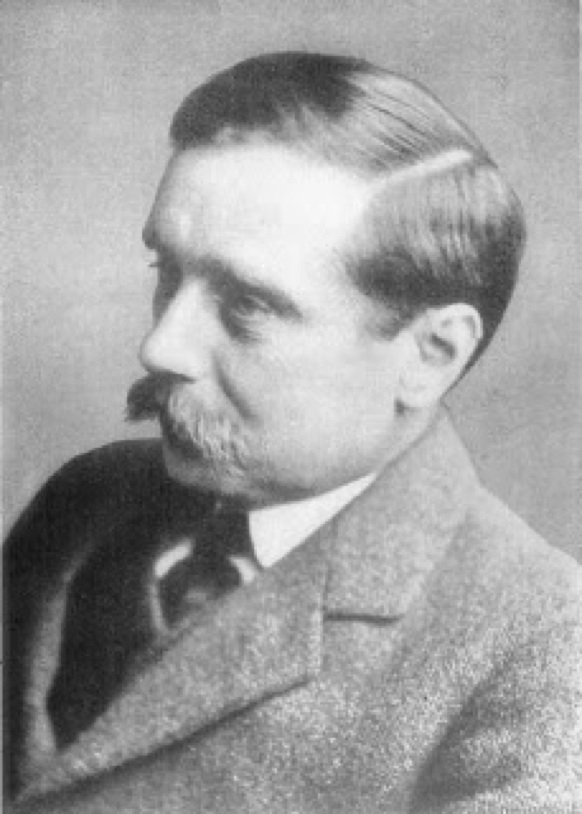
(Excerpted from Dave Creek’s commentary on THE WAR OF THE WORLDS)
H.G. Wells was born September 21st, 1866 in Bromley, Kent, a London suburb. His parents, once servants, then ran a glass and china shop.
Life's setbacks often guided Wells into productive areas. When he was seven, for instance, Wells suffered a broken leg. As he was mending, he became a compulsive reader. Wells's mother Sarah was forced back into domestic service when the china shop wasn't profitable enough to support them. His parents' misfortune only reinforced his reading habit -- Wells first encountered such works as PLATO’S REPUBLIC and GULLIVER’S TRAVELS in the library of Up Park, the country estate where his mother was housekeeper. Apprenticeships to drapers and a pharmacist followed, but young "Bertie" Wells was unsuccessful with each one. Alexei and Cory Panshin, in THE WORLD BEYOND THE HILL, say he "contrived to fail." The reason? The library at Up Park was waiting.
Most of Wells's formal education was at the Normal School of Science in South Kensington, London, which he attended from 1884-1887. He led the way in the founding of a school magazine -- the Science Schools Journal, which he served as its editor and a frequent contributor.
It was at the Normal School that Wells studied biology and zoology under Thomas Huxley, one of the most outspoken proponents of Darwin's theory of evolution. Wells was an admirer of Huxley, and later said the year with him was "beyond all question, the most educational year of my life." The Panshins say, "He revered Huxley as an intellectual giant of the same stature as Plato and Galileo...." Then Huxley grew ill and quit teaching, Wells didn't maintain his attention to his studies, his scholarship was taken away, and he dropped out.
A year after he left the Normal School, though, he contributed a story to Science Schools Journal. "The Chronic Argonauts" was an early version of the story that became THE TIME MACHINE. He spent the next few years teaching science, recuperating from an illness, and writing more fiction and essays. In 1890, Wells took exams that gave him his degree in zoology from London University.
Tragedies continued to strike. His marriage to his cousin Isabel in 1891 did not satisfy body or soul. His mother lost her job, as did his older brother Fred. Wells was now supporting his whole family. Then in 1893 he fell ill again.
Once again, though, adversity led Wells to a positive breakthrough. As he recuperated, he pushed ahead with his writing career. Now he found success, publishing humorous articles to the Pall Mall Gazette and other newspapers and magazines. His personal life turned around as well, when he divorced Isabel and married a former student, Amy Catherine Robbins.
When the book version of THE TIME MACHINE appeared in 1895, it was the first of a string of works that would solidify his position as one of the creators of modern science fiction (the other, of course, being Jules Verne).
Other "scientific romances" followed -- THE ISLAND OF DR. MOREAU, THE INVISIBLE MAN and, in 1898, THE WAR OF THE WORLDS. Although THE TIME MACHINE is considered by many his masterpiece, it is THE WAR OF THE WORLDS that has had the largest literary and popular influence.
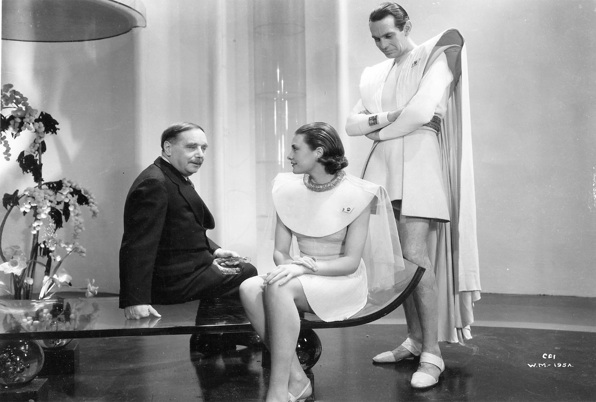
H.G. Wells on the set of THINGS TO COME, 1936